The Legs That Dressed the World: A Hosiery Loop Through Leicester
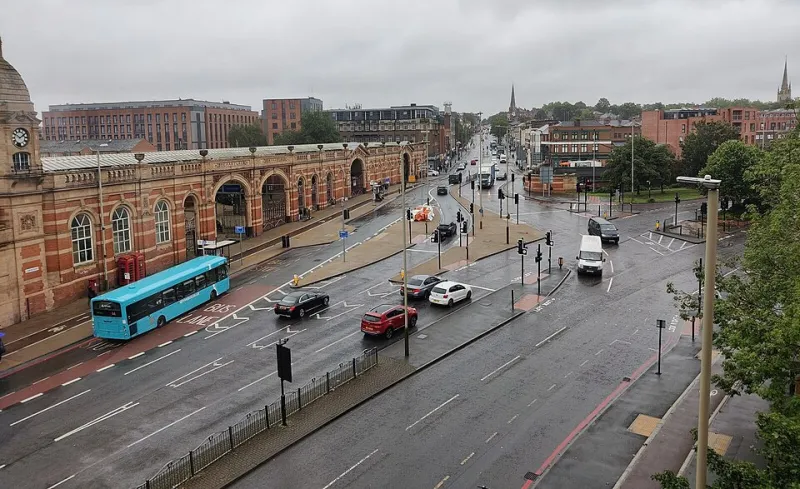
Photo: Mat Fascione , CC BY-SA 2.0, via Wikimedia Commons
Leicester has a habit of underplaying its own history. We will happily tell you about the king in the car park, the football club that did the impossible, and the curry houses that keep Belgrave Road humming. What we mention less often is that this city once clothed the legs of the world. Stockings, socks, underwear, swimwear, knitwear — for well over a century, Leicester made it, sold it and shipped it. The industry shaped the skyline, the street plan and, frankly, the city's sense of self. This loop is a quiet way to pay attention to that.
It is about two miles, flat, and mostly on pavement. You can do it in an hour if you stride, or a slow afternoon if you stop for coffee and read the plaques. Bring a waterproof and a willingness to look up.
Start where the city shows off
Begin at Town Hall Square, where the Victorian civic confidence is laid on thick. Walk down past the Clock Tower and turn onto St Martin's. You are already in the old garment district, even if the shopfronts now sell phone cases and bubble tea. Look at the upper floors: long windows, bricked-in loading doors, iron hoists still bolted to the walls. Those are the fingerprints of small workshops and warehouses that once handled hosiery by the crate.
The first proper stop is St Margaret's Church, the oldest surviving building in the city centre and a useful anchor. Around it, the streets once rang with the clatter of frames. Leicester's knitting trade grew out of the East Midlands framework knitting tradition — the stocking frame was invented in nearby Nottinghamshire in the late sixteenth century, and by the nineteenth century Leicester had become one of its most aggressive adopted homes. Workers did not always love it. The Luddite disturbances of 1811–16 were partly a revolt against cheap, wide frames that undercut skilled hands. Leicester was not a passive bystander to that argument.
The works and the walls
Head up towards St John Street and the edge of Abbey Park. The name Corah should be on your radar. Corah's was one of Leicester's giants, a hosiery firm that grew from a small family business into a St Margaret's Works operation employing thousands. The buildings have been reworked, as Leicester buildings tend to be, but the scale is still legible: long brick ranges, north-light roofs, the ghost of a chimney. Stand still for a minute and imagine the shift change. Then imagine the noise.
Wolsey is the other name to carry with you. For much of the twentieth century, Wolsey was Leicester knitwear — socks, underwear, the lot — and the company's mark turns up on old signs and tiles around the city. Byford's is another. You will not find a theme park here. What you find is layers: a factory gate here, a faded painted advert there, a street name that used to mean a works entrance.
Look for these details
- North-light roofs — the sawtooth ridges that let daylight into knitting sheds. Once you spot one, you will see them everywhere.
- Loading doors on upper floors — a sign that goods, not people, were the priority.
- Ghost signs — painted lettering on brick, often for hosiery, knitwear or dye works. Some are almost gone. That is the point.
- Terracotta and glazed brick — the fancy stuff on the front of works offices, a small attempt at dignity beside the sheds.
- Hoists and pulleys — ironwork above doorways, used to haul wool and finished goods.
- Street names and ginnels — cut-throughs and alleys that once served workshops and drying rooms.
Across the water and back
Carry on towards Abbey Park and the River Soar. The water was not decoration: the hosiery trade needed it for dyeing, washing and steam. Cross towards Frog Island and Belgrave, where the industry's footprint becomes more residential and more mixed. This is not a museum quarter. It is a working city that has changed its job. You will pass old warehouses now used for storage, studios, gyms, car repairs — the usual Leicester recycling of useful space.
If you want the museum version, Leicester Museum & Art Gallery on New Walk has social-history displays that touch on the city's textile trades, and the city's collections include knitting frames and garments that make the scale real. Check opening times before you go; museums, like factories, have a habit of changing their hours.
The honest bit
It would be easy to make this a nostalgic parade of busy workers and proud firms. The truth is more mixed. Hosiery gave Leicester jobs and a reputation, but it also gave long hours, low pay and periodic slumps. The industry's decline from the later twentieth century hit hard, and the garment trade that remains in the city has had its own uncomfortable headlines about working conditions. Leicester's relationship with making things is not a cosy story. It is a story about work, and work is complicated.
That is why the loop is worth doing slowly. The buildings are not just pretty brick. They are the shape of a city that made a living from other people's legs.
Buy a pair and walk home
Finish back at Leicester Market. The market has been the city's trading floor for centuries, and the sock and hosiery stalls are a direct line to the old trade — not a heritage exhibit, just people selling useful things. If you want something a bit more designed, the independents around Clarendon Park and the Lanes will sort you out. Buy a pair. Put them on. Walk home. That is the most Leicester ending available: no fuss, no plaque, just good socks and a city that still knows how to make them.
Route notes: Town Hall Square → Clock Tower → St Martin's → St Margaret's Church → St John Street → Abbey Park edge → Frog Island → Belgrave → Leicester Market. About 2 miles, flat, step-free in most places, with benches and cafés along the way. Best done in daylight; some back streets are quiet after dark.