The Steps Don’t Lie: A Postwar Precinct Loop Through Leicester
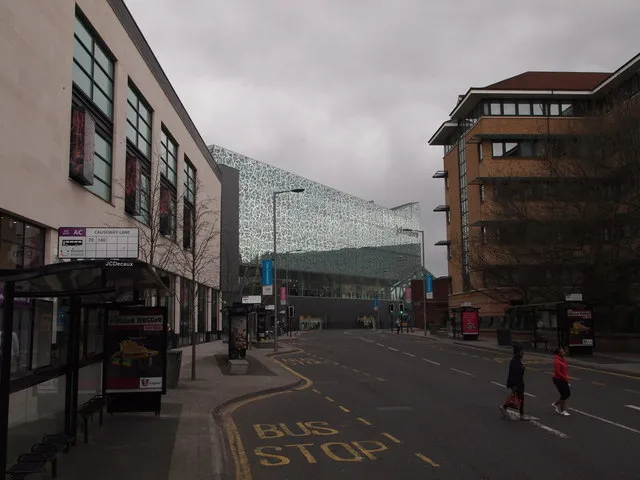
Leicester’s postwar precincts are easy to walk past. That is rather the point of them. They were designed for movement, for buses and shoppers and weather, and most of us use them as a means to an end: get to the Haymarket, cut through to the market, find the nearest exit. But if you slow down and take the long way round, the city starts to look like a place that once had a very clear idea of the future — and wasn’t shy about pouring it in concrete.
This is a loop for people who like their city walks with a side of overlooked design history. It is not a preservation lecture. It is a wander through the bits of Leicester that get called “dated” on the way to somewhere else, and a chance to notice what is still there in 2026.
Start at the Clock Tower, but look past it
The natural meeting point is the Clock Tower, that Victorian survivor surrounded by everything that came after. Most people look at the clock; look at the ground instead. The paving, the kerbs, the crossings and the bus stands are the quiet machinery of a pedestrian city. From here, head up Gallowtree Gate and let yourself drift left and right rather than marching straight ahead.
The first thing to notice is how many of the shopfronts have been reclad. Smooth panels, bright vinyl, LED strips. Underneath, though, the bones of the street are older and stranger: shallow steps, odd little ramps, service doors that once opened onto something more ambitious. This is postwar Leicester in its everyday clothes — not a grand set piece, but a working shopping street that has been redecorated many times.
The raised city
Keep going towards the Haymarket and the surrounding streets, and you start to see the precinct’s real personality: the raised walkway. Leicester, like plenty of British cities, briefly fell in love with the idea that shoppers should be lifted above the traffic. Decks, stairs, ramps and first-floor arcades promised a cleaner, drier version of the high street. Some of that promise is still visible if you look up.
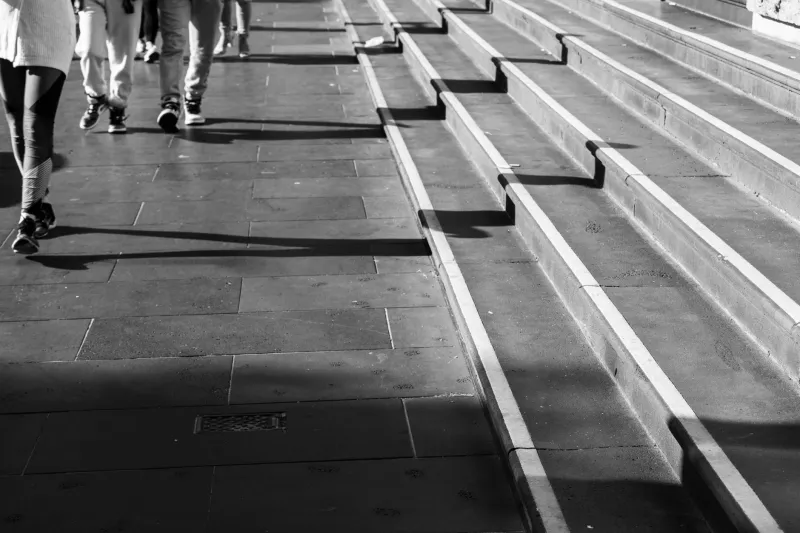
There is something oddly thrilling about climbing a concrete staircase that leads nowhere glamorous. The steps don’t lie: they tell you exactly what the planners thought of pedestrians, weather and cars. They also tell you how much has changed. A walkway that once felt futuristic now feels like a shortcut to a car park, or a place to wait for someone. That is not a failure. It is just history doing its usual thing.
Stand still for a minute on one of the upper levels. You get a different view of the city: rooftops, ventilation grilles, the backs of signs, the odd pigeon. It is not pretty in the postcard sense, but it is honest. Leicester’s precincts were built to be used, not admired, and you can feel that in every scuffed handrail.
Concrete that learned to wear colour
What saves these streets from being merely grey is the colour. Some of it is accidental — a bright shop sign, a painted shutter, a mural that has appeared since the last time you looked. Some of it is original. Look for the lettering and relief panels that survive above eye level, the kind of civic decoration that was meant to make a shopping centre feel like a public building rather than a shed.
The best bits are often the smallest. A tiled panel by a doorway. A bit of patterned brick. A sign in a font that no one would choose today but that somehow fits perfectly. These details are not treasures in the museum sense. They are the texture of a place that was designed with a bit of swagger.
This is where the loop becomes a bit opinionated. Leicester’s postwar precincts are often dismissed as ugly, and some of them are certainly awkward. But awkward is not the same as worthless. The raised walkways, the covered arcades and the stubborn concrete were attempts to make a modern city centre that worked for ordinary people. You don’t have to love them to admit they have more character than another sheet of grey cladding.
What the precincts got right
Walk on towards Charles Street, Church Gate and the edges of the market, and the loop starts to feel less like a tour of buildings and more like a lesson in urban manners. The precincts are permeable. You can cut through them. They shelter you from the rain. They connect the bus station to the shops to the market without making you feel like you are on a motorway. In 2026, when every city is talking about walkability and retrofit, that is not nothing.
The local voices you overhear in these streets are rarely sentimental. People complain about empty units, about the state of the paving, about the wind. But they also use the place. They meet under the clock, queue for buses, cut through the arcade, nip up the steps. The precinct is not a monument. It is a habit.
The quiet risk
That is also what makes it vulnerable. The bits that are easiest to lose are not the big buildings but the small stuff: signs, railings, floor tiles, stairwells, the odd bit of public art that nobody has nominated for listing. When a facade is refreshed or a unit is split, these details often disappear without a planning debate. Leicester’s postwar precincts are not about to vanish overnight, but they are being quietly sanded down.
The risk is not that the city changes. Cities always change. The risk is that we replace something specific with something generic, and then wonder why the place feels flatter. A walk like this is a small act of noticing. It says: this corner is worth a second look before it is smoothed away.
Finish by the market
End your loop near Leicester Market, where the postwar city meets the much older one. The contrast is the point. You have just walked through a version of Leicester that believed in decks and ramps and civic swagger, and now you are back among stalls and awnings and the smell of coffee. Neither is the “real” city. Both are.
If you do this walk on a damp afternoon — and Leicester does damp very well — you will probably have the upper walkways to yourself. Take that as an invitation. Climb the steps. Look at the lettering. Stand where the planners wanted you to stand. The precincts may not be beautiful in the way that a cathedral is beautiful, but they are full of evidence. And evidence is what a city walk is for.