The City That Never Stopped Playing: A Sporting Walk from Filbert Way to Welford Road
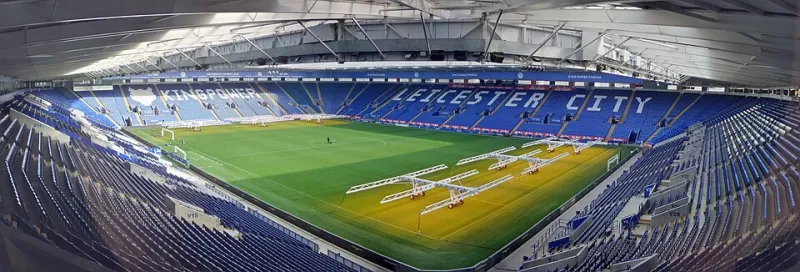
Photo: Pottercomuneo, CC BY-SA 4.0, via Wikimedia Commons
Leicester doesn't do quiet sporting history. It does arguments in pub gardens, scarves on matchday mornings, and a stubborn belief that the city's teams belong in the conversation. This loop takes that conversation for a walk: roughly three miles from the old Filbert Street site to the King Power Stadium, then up to Welford Road, with a pint in the middle and plenty of time to disagree about who was the greatest.
Starting where the noise began
Begin on Upperton Road, where the terraced streets still carry the shape of the old Filbert Street ground. Leicester City played here from 1891 until 2002 — 111 years of noise, mud, floodlights and last-minute goals. The stadium is gone, replaced by housing, but a plaque and a few street names keep the memory in view. Stand for a minute and imagine the queues: the smell of onions, the click of turnstiles, the pre-match ritual of squeezing past the same people you stood next to every other week.
Filbert Street wasn't a grand cathedral of football. It was tight, awkward and brilliant for it. The away end was famously close to the pitch; the atmosphere could be fierce. When the club moved to the King Power in 2002, it swapped intimacy for capacity — and the city is still divided on whether that was a fair trade.
Concrete that remembers
Walk south-west along Upperton Road, cross the canal, and follow Filbert Way to the King Power Stadium. The route is flat and mostly pavement, with the kind of post-industrial edges that Leicester does well: warehouse conversions, a canal towpath, and the sudden, blue-tinted bulk of the stadium.
The King Power opened in 2002, the same year Filbert Street closed, which gives the city an unusually neat handover. It's a proper modern ground: steep stands, a bowl of blue seats, and a pitch that looks enormous from the back row. The trophy cabinet has had a strange, wonderful decade — the Premier League in 2016, the FA Cup in 2021 — and the stadium tour is worth booking if you want the behind-the-scenes version. On matchdays, the approach from the city is a slow river of blue: cars, buses, fans on foot, someone selling badges from a tray.
A half-time pint with no half-time
Loop back towards Aylestone Road and stop at The Western, a proper matchday pub with a loyal pre-match crowd. On a non-matchday it's a quiet place to plan the rest of the walk; on a matchday you'll be shoulder to shoulder, shouting over the noise. Either way, it's the sort of pub where the landlord knows the season ticket holders by name and the conversation drifts from the latest result to the 1990s without warning.
Alternatively, save your pint for The Donkey on Welford Road, which is the rugby equivalent: a pub that lives and breathes the Tigers. The choice depends on whether you want your half-time chat to be about football or rugby. There is no wrong answer, but there is a correct one depending on who you're walking with.
Up the road to rugby country
From Aylestone Road, turn north-east onto Welford Road and follow it until the stadium appears. Leicester Tigers have played here since 1892, which makes Welford Road one of the oldest continuously used club rugby grounds in the world. The Crumbie Stand — the old terrace — is still there, a proper slice of sporting architecture that smells of history and faintly of beer. The ground has been redeveloped around it, capacity creeping up, but the Crumbie keeps the place honest.
Rugby in Leicester is not a side interest. It's a parallel universe with its own vocabulary, its own matchday rituals and its own pub arguments. The Tigers' history is long and successful, and the city wears it lightly — there's no smugness about it, just a quiet expectation that the team should be good. If you're lucky enough to be here on a matchday, stand on the terrace for twenty minutes. The noise is different from football: more collective, less frantic, and somehow older.
The debate that never ends
End the loop back in the city centre, or stay on Welford Road and let the pub debate take over. Ask five Leicester fans who the club's greatest player is and you'll get six answers: Gordon Banks, Gary Lineker, Jamie Vardy, Emile Heskey, someone's uncle who played three games in 1974. Ask the rugby crowd and you'll get another set entirely. The point isn't to settle it. The point is that the argument is the sport's second life, carried on in pubs and kitchens and group chats long after the final whistle.
Route notes
Distance: about three miles, flat, on pavements and towpath. Allow 90 minutes walking, or three hours with stops. Start at Upperton Road (bus routes from the city centre are frequent); finish at Welford Road, a 15-minute walk from the station. If you want to extend, Grace Road — home of Leicestershire County Cricket Club — is a short detour south-east, and Victoria Park adds a green, sporty loop back towards the centre. Best done on a Saturday morning, before the crowds arrive, or on a matchday if you want the full noise.
Leicester's sporting identity isn't just about the big grounds. It's in the parks where kids play, the school pitches, the five-a-side cages, the boxing gyms and the running clubs. The stadiums are the loudest part of the story, but they're not the whole story. This walk is a way of hearing the rest of it: the city that never stopped playing, long after the goals and tries are scored.