A Plaque Is an Argument: Walking Leicester's Bronze, Stone and Half-Remembered Stories
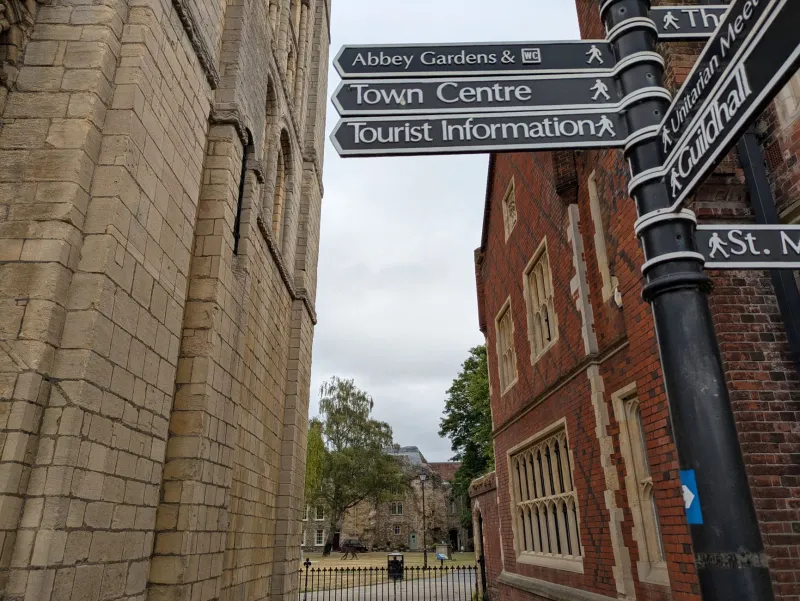
Leicester is good at remembering loudly. You cannot move for Richard III, football history or a decent Diwali story. But the city also remembers quietly: a blue plaque on a brick wall, a statue with its back to the traffic, a bench slat carrying a name that only one family still reads. This loop is about those smaller commemorations — the ones you have to look up, slow down or squint for.
It is not a tour of Leicester's greatest hits. It is a walk through the editing process. A plaque is an argument in metal: someone decided this person, this building, this moment deserved to interrupt your day. The interesting question is not just who got one, but who did not.
The route at a glance
Start at Town Hall Square, head through the Guildhall yard to Cathedral Gardens, dip into Castle Park and the Jewry Wall, then follow The Newarke and Welford Road towards New Walk. Finish near the railway station, where Thomas Cook waits in bronze. It is about two and a half miles, or two hours at a proper pottering pace. Add tea stops and you have an afternoon.
The surfaces are mostly pavements, but there are cobbles near the Guildhall and uneven bits in Castle Park. It is not a fully step-free route, so allow extra time if you are pushing a buggy or using wheels. A dry weekday is ideal: fewer crowds, more room to read the small print.
Town Hall Square: the official nod
Begin where civic Leicester likes to clear its throat. The Town Hall's Victorian stonework is confident enough to make a plaque feel redundant, but look around the edges of the square and you will find the city's commemorative habits in miniature. Official memorials tend to be vertical, formal and slightly above eye level. They are designed to be noticed, not touched.
This is a good place to set your question for the day: what counts as history here? A mayor, a benefactor, a building that survived? Or the market trader, the factory worker, the neighbour who kept the street going? Leicester's blue plaques, many of them cared for by the Leicester Civic Society, do a decent job of mixing buildings and people. But they are still a curated list, not a census.
The Guildhall and the awkward guest list
Walk through the Guildhall yard and you are standing in one of the city's oldest surviving civic spaces. The building itself is the memorial: timber, stone and about six centuries of administrative groans. There is no need for a plaque to explain why it matters. Sometimes the oldest thing in the room is the argument.
But the Guildhall also shows how commemoration works. Buildings survive because someone found a use for them. People get plaques because someone kept the paperwork, the address and the enthusiasm. The awkward guest list is not a conspiracy; it is just what happens when memory depends on volunteers, budgets and a listed wall.
Cathedral Gardens: kings, suffragettes and a soapbox
At Cathedral Gardens, Leicester remembers a king. The Richard III story is now so well told that the statue and the tomb almost feel like part of the street furniture. It is a remarkable piece of historical recovery — and a reminder that commemoration can be a media event as much as a stone one.
A short walk away, the Alice Hawkins statue does a different job. Here is a suffragette, a working woman, a campaigner who was once considered inconvenient. The statue gives her a public voice and a bit of attitude. It is a useful contrast: one figure is remembered because the institutional story demanded it; the other because people campaigned to put her there. Same city, different route to bronze.
Jewry Wall and the long memory
The Jewry Wall does not need a plaque to make its point. Roman Leicester is right there in the brickwork, older than most of the names on the city's memorials. It is a good place to remember that commemoration is not only about people. Sometimes a place survives and becomes its own monument.
From here, Castle Park and The Newarke offer a quieter kind of remembering. There are church memorials, gateways and stones that have outlasted the institutions that made them. Some commemorate a person; some just commemorate survival. Both are worth a pause.
New Walk: the polite promenade
New Walk is Leicester at its most self-consciously elegant: a pedestrian promenade with a Victorian sense of its own importance. It is also plaque territory. Here, the city celebrates its professional and cultural figures in a way that feels almost like a reading list. Look for the names, but also look for the gaps. Who gets a polite promenade and who gets a pub sign?
Finish at the station, where the Thomas Cook statue stands outside like a bronze handshake. It is a neat ending. Leicester's travel story is not just about grand tours; it is about excursions, package holidays and the idea that ordinary people deserve to go somewhere. A fitting last stop for a walk about who gets remembered.
Why some stories fade
Commemoration follows money, institutional energy and fashion. A blue plaque usually needs a building to survive. If the building is demolished, the story often becomes a line in a local history book and a shrug on a street corner. Women, workers and migrant communities have historically appeared less often on official lists, though that is changing. Alice Hawkins is proof that the list can be edited.
Unofficial memorials matter too: pub names, murals, football scarves tied to a railing, a bunch of flowers on a bench. They are less permanent, but they are often more honest. They show what people actually care about, rather than what a committee has agreed to unveil.
Pit stops for reflection and tea
The café at Leicester Cathedral is a sensible first pause — central, calm and close to the route's big questions. Loseby Lane offers independent options if you want to make a proper sit-down of it. Near the end, the cafés around New Walk are good for a final cup and a debrief. The walk works best if you build in at least one stop where you do nothing but look out of the window and decide which plaque you would add.
Practical bits
Allow two to two and a half hours without stops, or a comfortable afternoon with tea. Start at Town Hall Square, which is well served by buses, and finish at Leicester railway station. The route is mostly level but includes cobbles and uneven park paths. Go on a dry day, take a phone torch for the darker corners in winter, and resist the urge to read every plaque aloud. Save one for the walk home.